
“Will This Iguana Jump on Me?”: A Visit with Crow Saidel at the Petaluma High School Wildlife Museum
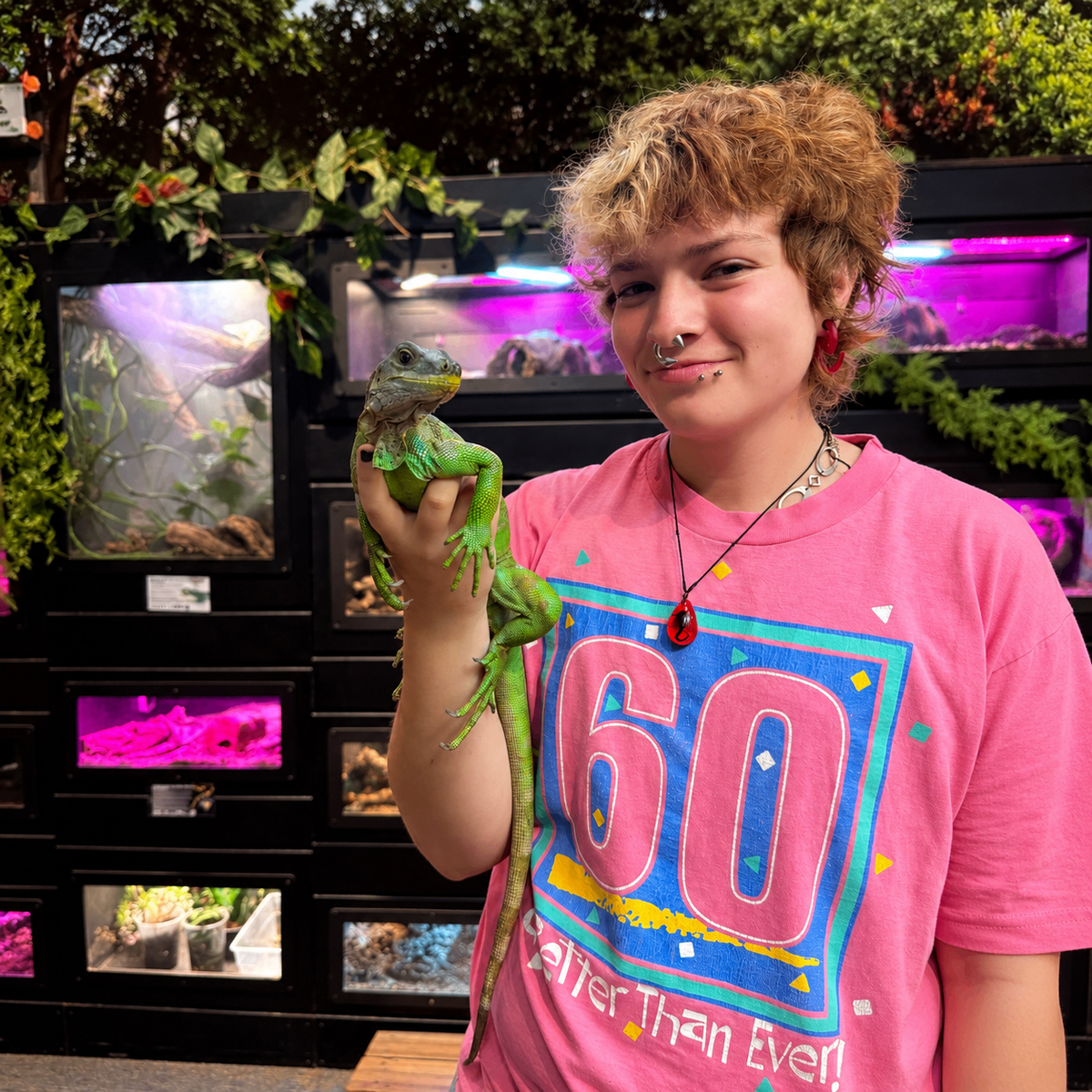
Crow Saidel is a senior at Petaluma High School and a lead docent at the @Petaluma Wildlife Museum. I went in afraid of snakes and came out still afraid, and also completely excited about what the students are learning.
I told Crow that I was hesitant to be around reptiles, and he got Rufio out of his enclosure anyway. "You don't have to be scared of him," Crow reassured me.
Rufio is a Saint Lucia horned iguana, about four years old, bright green and going white around the head. Crow held him upside down for a moment to settle him, which is a thing they do at the museum and call air jail. Rufio is arboreal, so being off the ground calms him down.
Then he told me what is happening to these iguanas in the wild. Green iguanas are invasive on Saint Lucia, and people trying to kill those sometimes kill juvenile horned iguanas by mistake, because the two look alike at that age. The ones that survive end up breeding with the invasive species, which thins out what little gene pool is left. They are not on the endangered species list, and Crow thinks they should be.
Would you rather
The visit had started a few minutes earlier in Shareen Jackson's public speaking class. She opens every class with a would you rather, and each student's answer is how she takes attendance. That day the question was "Would you rather have the wings of a butterfly, or a butt that lights up like a firefly?” The class did not take this lightly. Can you fly with the wings? Yes, but they won't be very hearty. Why does the butt glow? To attract a mate, so it turns on when someone you like is nearby.
The vote was split, and then everyone moved on to their work for the class time.
Crow got into the program freshman year, through exotic animal husbandry, which he did not expect. Freshmen mostly did not get in, and he says it was the first year in a long time they let any in at all. The appeal had been building for a while before that.
"We would walk around the school sometimes and we'd see the tortoises in the tortoise garden outside. I've always just really loved animals and being outside and working with animals. So it's kind of a dream come true."
The script
Sophomore year came the public speaking for environmental education class, taught then by Phil Tacata, who Crow says is the one who got him into public speaking. It also brought a pivotal memory in Crow's experience.
During this course, students write their own scripts about an animal. Crow picked the western hognose snake. He wrote the whole script, but did not memorize a single word of it, and he did not record it the way the instructor had asked.
"He (Tacata) was like, Crow, you have to present in front of the entire class. And I was like, shoot. I cannot do this."
Crow said he got very anxious, and then worked it out with the instructor, who allowed a few days' delay for the presentation. In those days, he spent his time rereading the script until it was memorized.
"It really taught me, if you're gonna be in this program, you have to put in the work. It's not just something where you can kind of do it halfway. You actually have to know your stuff."
The method changed after that. He memorizes bullet points now rather than whole sentences, and builds the talk around them differently each time, which is why he can start one anywhere and not lose the thread.
Four years later he is a lead docent in the reptile room, where most of the museum's live animals are.
The class has a rhythm. You arrive already dressed, purple polo on, everything prepped. Shareen Jackson tells you how many people are on the tour and how many groups. Then you go to your zone. There are usually five, sometimes six if the group is big, and each one runs eight or nine minutes. Lead docents like Crow facilitate the scripts and keep the tour moving. Lead keepers run the husbandry side, the students do it all from start to finish.
Crow says he has picked up most of the museum's scripts just by listening to other people present them. The tours are mostly elementary school groups, kindergarten through sixth, and he says they are running more of them than they ever have.
Voldemort
He says the hognose has remained a special reptile, and walked me over to her enclosure. Then he gave me the presentation.
Her name is Voldemort. She is the only venomous snake in the building, though Crow is quick to qualify it. She is rear fanged rather than hypodermic fanged like a rattlesnake, so she chews her venom in rather than injecting it, and the venom itself is weak enough that it barely counts.
"It's only about as bad as a bee sting."
What it does is remarkable. One of her main food sources is poisonous toads, and her venom breaks down the poison so she can eat them.
Showing me an animal, sharing a fact about it, and then explaining why the animal is in trouble, or was in trouble and is on the mend, became the pattern of our tour. Vizzini the Chinese water dragon came to the museum with metabolic bone disease, after previous owners kept him in a chicken coop outside without the light or the calcium or the room to move that he needed, and he has arthritis now. He was also, the day I visited, moving around more than usual.
The taxidermy hall
Most of that collection came from Hugh Codding, the Santa Rosa developer, who donated his own private museum to the school in 1989. Crow says a lot of the mounts were trophy hunted by Codding himself, and that on some of them you can still find the bullet hole.
Codding's widow recently gave the museum $100,000, which Crow says is going toward new signage and an expanded tortoise garden. The museum has over sixty animals and over forty-species. Open houses are Saturdays, 11am-3pm.
After graduation, Crow is headed toward conservation and education, probably marine biology.
"I've really grown to love educating people about conservation."
Thank you, Crow, for your time and the tour. Thank you to Porches members and Crow's parents, @Kate Sheehy and @Michael Saidel, for connecting us. And thank you to the team at @Petaluma High School who welcomed this and made it happen. What a great team!