

Why does the power keep going out in Petaluma?
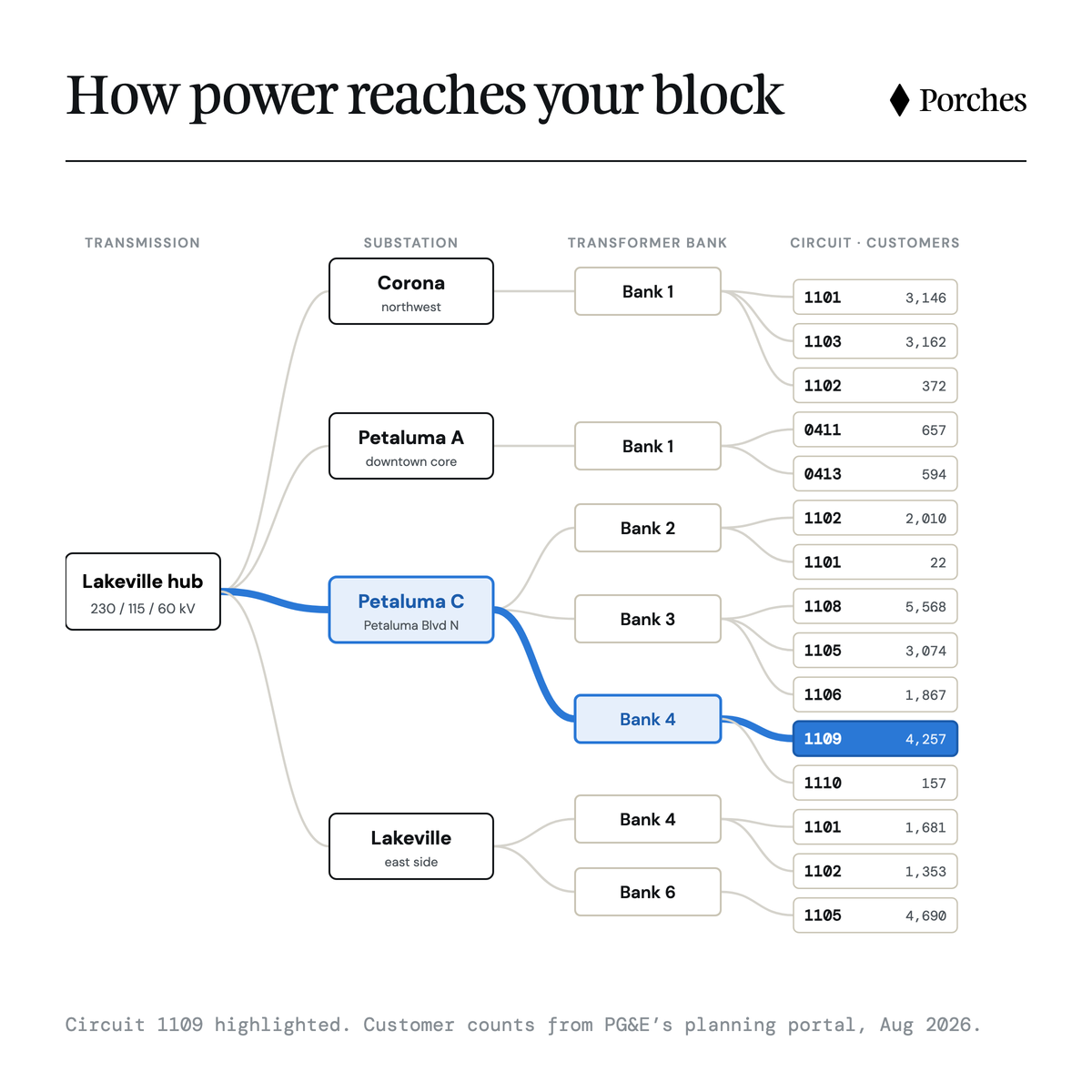
This is a public-records dig into why the lights keep going out in Petaluma. PG&E has not yet shared specifics on what failed on any of the recent outages, and I do not have a definitive smoking gun answer either. But I did find some interesting data that might help put the recent outages into context.
♦️♦️♦️♦️♦️
Yesterday the power went out twice in Petaluma. A little after 9am, about 4,900 customers lost power across five simultaneous outages. Power was back by 12:30pm, but then dropped again at 2:53pm. There were also significant outages on August 25, 26, and 28.
We’re now at six outages in nine days across town.
So what is going on?
PG&E's explanation for yesterday, given to the Press Democrat, was light on details: "an equipment issue on a PG&E transmission line." I was curious to see if there was anything else I could find.
First: a little primer on how the grid system works. Almost all of Petaluma's power comes in through the Lakeville substation on the east side of town, a big transmission yard where the 230k volt lines from the statewide grid land in town. Four substations step the power down to 12k volts: Corona, Petaluma A, Petaluma C, and Lakeville. Inside each substation, transformer banks send out circuits to the poles outside your house. There are 15 individual circuits in Petaluma.
Setting aside yesterday, which was a bigger transmission line issue (upstream of every circuit in town), the outages of the previous two weeks trace almost entirely to two circuits. One is Lakeville 1102, which serves the northeast side near Penngrove. The other, and the bigger one by far, is circuit Petaluma C 1109, which leaves its substation on Petaluma Blvd North, crosses downtown, then fans out south through the Sunnyslope hills and east across Lakeville.
Petaluma C 1109 is one of the most problematic circuits in the state.
Before we get into why, there’s one more important bit of history. In July 2021, weeks after their equipment started the Dixie Fire (the largest single-source wildfire in state history), PG&E turned on "fast-trip" settings on its circuits in fire-prone areas, and expanded them to all such circuits in 2022.
Here’s how the state utilities commission describes the system:
“(Fast trip settings) are utility programs intended to reduce wildfire risk by significantly increasing the sensitivity of protective devices and equipment that trigger automatic outages when a fault is detected. If an object contacts a distribution line, or a fault occurs, protective devices such as circuit breakers, line reclosers, and fuse savers automatically shut off power within one-tenth of a second. The electric utilities may reduce wildfire risk, but the new settings have also resulted in unplanned outages for which advance notification is not possible.”
This is a pretty cool system, I think!
PG&E claims a 65 percent drop in ignitions on protected lines in 2024 and its fewest fire-zone ignitions on record in 2025. It makes intuitive sense. But we must accept the trade-off of more unplanned small outages like the ones we've been seeing in the past few weeks.
Since implementing this system, PG&E reports every fast-trip outage to the Public Utilities Commission, by circuit, each month. So we have an interesting leaderboard of data to look at.
Of the 941 circuits statewide that tripped at least once from 2022 through this July, Petaluma C 1109 is tied for 42nd in trip count, in the top 5 percent. In 2024, it ranked fourth in the entire state.
If you look at the other locations that top the list (Templeton, Placerville, Garberville, Hoopa, the Napa hills, etc.), many of them share a geographic quirk in common with Petaluma C 1109. They are long circuits that start in a town, then run out into the wooded countryside. In Petaluma's case, a branch, bird, or squirrel in the rural hills can take the power out downtown.
Petaluma C 1109 is notable for another reason too: demand and capacity.
PG&E forecasts demand on 1109 rising 50% by 2035, the most of any circuit in Petaluma, and in the 83rd percentile among PG&E's large circuits of 3K+ customers. Every circuit has a rating, the most power its wire can carry before overheating. PG&E's forecast has peak demand on circuit 1109 at 93% of that rating this summer and 139% by 2035, which puts it in the 95th percentile of PG&E circuits by forecast overload.
What’s the resolution?
PG&E has some standard remedies for this type of situation that it lays out in its wildfire plan, including sectionalizing devices, which would let the rural end of the circuit trip without taking the town down with it.
PG&E actually did install these on the neighboring circuit 1108 and on Lakeville 1102 in 2023 and 2024, but has not done so on circuit 1109, where its only work so far has been adding eleven fault-locating sensors and two animal guards. There is no capacity or hardening project listed for 1109 in PG&E's public planning filings, and no plans to bury the line underground, which would be the real durable solution.
We don’t know exactly why the power keeps going out in Petaluma. But I think it’s notable that we have a particularly problematic circuit, Petaluma C 1109 – in both the top 5% of the fast-trip leaderboard and the top 5% for forecast overload – which has been at the center of most of our recent outages, and with a known solution for how to improve it.
♦️♦️♦️♦️♦️
Sources:
PG&E fast-trip outage reports to the CPUC, 2022 to August 2026 (California Public Utilities Commission)
PG&E Grid Resource Integration Portal, planning data updated August 21, 2026 (PG&E)
PG&E 2025 Distribution Upgrade Project Report (CPUC filing, August 2025)
Enhanced Powerline Safety Settings program page (PG&E)
Sonoma County undergrounding map, April 2026 (PG&E)
Sonoma County power outage alert feed (PowerOutage.us via Nextdoor)
Petaluma power outage affects more than 3,000 customers (Press Democrat, September 2–3, 2026)
PG&E's EPSS: here's why your power could be shut off (KSBY, San Luis Obispo)