

Where have all the 9th graders gone?
This is part two in a data storytelling series on Petaluma's public schools. It’s based on a work-in-progress dashboard with charts, insights, and data at petalumaschools.com. You can read part one here.
♦️♦️♦️♦️♦️
Petaluma's public schools are shrinking
In Part 1, we shared that Petaluma City Schools enrollment is down about 9% from its peak around two decades ago, while the city’s population grew by about 6% in that same stretch.
The first explanation is somewhat straightforward. The number of school-aged children in town has declined significantly, even as our overall population ticks up. This may not be shocking news – we’re in the midst of a broad demographic shift throughout the country (and most of the world) as life expectancies increase, while birth rates decline. But one thing that did surprise me was how extreme a shift is playing out here in Petaluma, relative to our peers.
Petaluma is aging
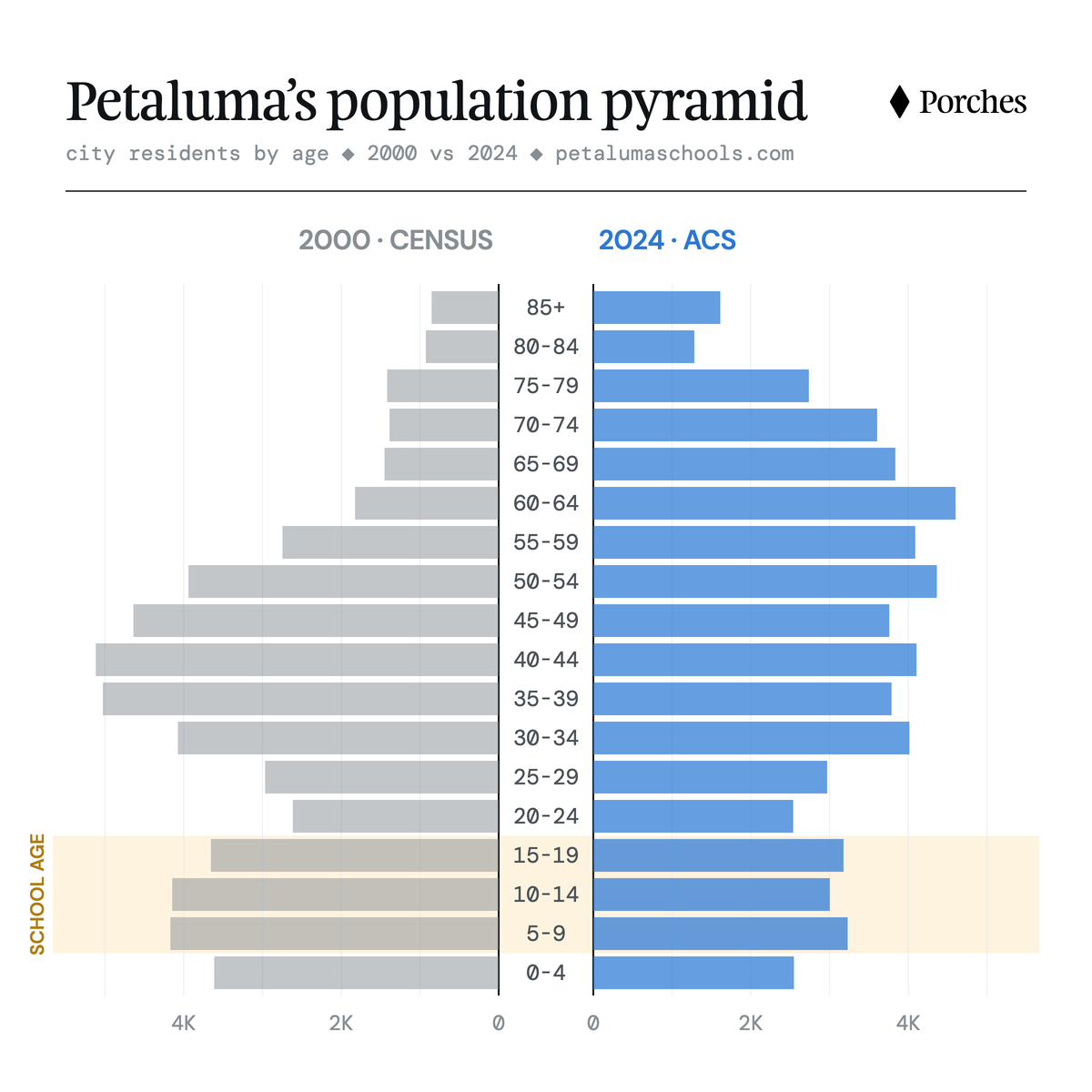
In the 2000 census, there were 10,666 Petalumans aged 5-17. By 2024 that number was 8,235. That’s a 23% decline! Meanwhile, Sonoma County overall is down 17%, California is down 4%, and San Francisco is down 2%. Marin is actually up by 5%.
In that same period, the number of Petalumans above the age of 65 has grown by 117%, compared to +80% in Sonoma County, +38% in SF, +84% in Marin, and +71% in California overall.
So Petaluma is experiencing a uniquely extreme demographic shift, which is the #1 cause of our public school population declining. The first chart pictured ("Petalumas population pyramid") shows the trend clearly.
There was some good discussion in the comments of my last post from @Matthew Ingram, @Jessie Feller, Mayor @Kevin McDonnell, and others on the demographic shift and its causes, which no doubt include housing stock, cost of living, and local job opportunities. That’s a meaty enough topic for its own deep dive, but today’s post is specifically about public schools. And if you dig a bit deeper, the demographic shift is only one part of the story.
The ninth grade cliff
The public school enrollment decline is highly uneven. Elementary schools are down 6% from their peak, middle grades are down about 17%, and high school enrollment is down by 22%. One obvious culprit could be graduation rates – are high school students just not graduating? But that’s not it. Graduation rates have actually improved over time.
Instead, it’s a front door trend. For every 100 eighth graders in Petaluma public schools one year, roughly 92 end up in Petaluma public schools for ninth. Interestingly, Petaluma public schools used to gain students from 8 → 9, likely as private or homeschooled K-8 students joined the system. But then around 2010, the numbers flipped. You can see it play out in the red and blue checkerboard chart ("Net arrivals by grade") – each cell indicates whether the public school system gained or lost students that year, for that grade. Blue cells represent a gain, red cells represent a loss. Since these follow the exact same cohort of kids, this can’t be explained by the demographic shift alone.
One obvious answer could be private schools. But local and nearby private high schools have been mostly flat or even shrinking over that same period, so that does not appear to be the source of the 9th grade drop-off.
The Credo clue
What about other public schools, just outside of Petaluma? This looks like a promising thread.
Cotati–Rohnert Park Unified has two specialized high schools, Technology High and Credo, that attract students from outside the immediate community. And to the South, Marin School of the Arts is another specialized program within Novato High School that does the same.
We don’t have public data on the residency of students from these schools (i.e. where exactly their students live), but the timing lines up. Credo opened up in 2011, the same year that Petaluma’s ninth grade hand-off dropped below 100. Credo is a public Waldorf charter school, and this timing also lines up with the first cohorts from Petaluma’s elementary Waldorf charter (Live Oak, which opened in 2001, and just recently transitioned to Valley Vista Public Waldorf) reaching high school age. As there is no corresponding Waldorf high school in Petaluma, Credo is a natural choice for families who want to continue on the Waldorf path, and they give explicit lottery preference to students already attending a K-8 public Waldorf school.
At this point, the Cotati-Rohnert Park school district takes in more than 130 ninth graders for every 100 8th graders, so they’ve become a net-importer while Petaluma has become a net-exporter. Novato Unified (which includes MSA) is also a net importer now, at 120 per 100, and has been growing steadily. You can see all these ratios over time in the third chart (The grade-9 handoff).
So we have a rough shape at least of an answer to the question of “Where have all the 9th graders gone?”. To a large extent, they are just not here any more, as the school-aged population has declined in a major way. And we have some evidence to rule out some other possible explanations: they don’t appear to be dropping out entirely, or transitioning to local private schools in huge numbers. There’s a fair bit of circumstantial evidence to suggest that Credo and other neighboring schools have become a big enough destination for Petalumans to show up significantly in the numbers.
What to make of this?
Across Petaluma, families have a broad range of public options during the elementary years: a public Montessori charter at River Montessori, a public Waldorf charter at Valley Vista, year-round multi-age classrooms at Cherry Valley, and Spanish-English immersion at Loma Vista. Neighborhood schools also have their own identities and strengths across academics, the arts, athletics, enrichment, and school culture. That range of choices is a big draw for young families, including ours!
Given the outflow at ninth grade, it is worth asking whether similarly distinctive pathways could be extended within Petaluma’s high schools, and whether that might give more local students a reason to remain in the district.
There is a meaningful financial stake. If enrollment in grades 9–12 had declined at only the same rate as grades 1–8 since 2003–04, Petaluma would have roughly 400 more high-school students today. Because most state funding follows average daily attendance, that represents around $5 million a year in gross funding for a non-basic-aid district like Petaluma Joint Union High.
Serving more students would also cost more, of course, so it's not just net-new funding. But some costs are also fixed. Petaluma still operates two comprehensive high-school campuses, even as fewer students and fewer dollars are spread across them.
I know expanding high-school options is much easier said than done. But I’d be curious to hear what families and educators think, and I’m keen to dig further into questions such as how Petaluma’s elective offerings have changed over the years, like whether there is already some specialization at play between Casa Grande and Petaluma High. Some early versions of that analysis are already online at petalumaschools.com.