
Jacob Dunn and the Long Legacy of Petaluma High Agriculture
I had the pleasure of speaking with Jacob Dunn, who runs the Ag Mechanics program at Petaluma High School. Jake was kind in scheduling our call, timed carefully between the Sonoma Marin Fair and the Sonoma County Fair, two of the program's busiest stretches of the summer. Our conversation was an education on the agriculture trades, on legacy, and on what it looks like to come home.
Jake is a Petaluman who left, taught in the Central Valley for a decade, and came back in 2012 to teach the same program he came up in. He's been at it here for thirteen years alongside his teaching partner Kim Arntz, and if you know a Petaluma kid who's been anywhere near ag or welding or FFA, you know Jake's work.
Jake grew up just outside of town, went to Wilson School, and got into 4-H in fourth grade because his friends were doing it. His dad was in the Coast Guard, so the family only moved once (a year and a half up in Fort Bragg before coming back). His neighbor raised sheep and used to pay him a quarter, or a soda, to help. "Sodas were pretty intriguing," he says. By seventh grade he was raising pigs, and his future ag teacher was the guy he was buying them from. When he got to Petaluma High, he joined FFA (which stands for Future Farmers of America), and he learned the trade under the late Bill King, who taught at Petaluma High for nearly 40 years starting in the 1960s. Bill coached the state championship mechanics team that Jake was on his senior year, and Jake served as a regional FFA officer. Petaluma FFA has been shaping students in this community for over 100 years, and Jake is part of that continuum.
From high school, Jake went straight to Cal Poly to study ag engineering. His original plan was to come home and design dairies for the Petaluma dairymen. "Over the last 30 years, that number has been going down and not going up," he says. So the plan needed a rewrite. He worked in viticulture in the Central Valley for a year, didn't love it, and went back to Cal Poly for his teaching credential.
His ag teacher had actually written in his graduation card that Jake should consider teaching. He spent four years teaching in Newman, a small farm town on the west side of the Central Valley, then six years at J.H. Pitman High School in Turlock. Bill King had retired by then, and a few teachers had come through the Petaluma program without sticking. Jake's wife's family, originally from the Central Valley, decided to relocate to Oklahoma. He and his wife looked at Oklahoma versus Petaluma. For Jake, it was an easy choice. They came back to Petaluma in 2012.
The Petaluma High FFA program covers three main pathways:
Agricultural Mechanics
Agricultural Science
Wildlife and Natural Resources
Jake teaches Intro to Ag Mechanics, which introduces students to plumbing, electrical wiring, sheet metal work, cold metal work, carpentry, and shop safety. He teaches Ag Welding and Advanced Ag Welding, where kids move from learning the craft to building real projects. He and Kim co-advise the Petaluma FFA chapter using what they call the three-circle model: classroom instruction, supervised agricultural experience projects (a student might raise livestock for the fair, run their own landscaping business, or work at a local farm), and the FFA leadership component that covers public speaking, career development events, and competition.
"My job is to open doors," Jake says of his teaching philosophy, "and hopefully they'll choose one that they can go through. And if that one doesn't work, there's lots of other ones."
The county fair is their biggest showcase. This year they dropped off 94 individual student projects and had close to 500 entries across livestock and ag mechanics. Projects ranged from student-made push sticks for feeding shop equipment to a four-post structure with a quartzite countertop and two swings hanging from it. Over the years, their dairy cattle judging teams have been competitive enough that two past teams have traveled to Scotland to judge cattle internationally. Their dairy products team competes in the kind of tasting contest immortalized in Napoleon Dynamite (yes, cows really do taste like the food they eat; Jake laughs and tells me to think about that before you bottle the milk).
Whether they stay in ag or take the skills somewhere else, the students carry the program with them. Recent graduates have gone to Cal Poly, Fresno State, and Cornell, where this year's chapter secretary is off to. Adam Jason went to Western Welding Academy in Wyoming out of high school, did pipeline welding in the Southwest, and just moved home to do custom welding work locally. Anthony Hawkins builds custom flatbeds for pickup trucks out of his shop in Petaluma. A steady stream of graduates go into the electrical trades, HVAC apprenticeships, and small businesses across the North Bay. Some go on to teach: three Petaluma FFA alumni now teach ag at other Sonoma County high schools. "Turning out teachers to hopefully replace us because we've been doing it for a while," Jake says.
Jake is candid about the bigger picture. His generation was told college was the only path to success, and the country now has a deep deficit of skilled tradespeople. Petaluma High is fortunate to still have its auto shop, metal shop, and wood shop, and Jake's intro-to-welding class is articulated with the Junior College so students earn JC credit while still in high school. Students from Casa Grande can even come over to Petaluma High during the school day to take welding, which he says not enough kids know is an option.
He puts it plainly: "This really is the last time they'll ever be able to do any of that for free in their lives. Even if they find out they can't stand to do it, it's better to figure that out before you go pay a bunch of money at a college to learn that, or go sign a contract and go to work for somebody and figure out you really don't like hooking up electrical wires."
The program is growing at both ends, both in Ag Mechanics and FFA. Kim started teaching ag classes at the @Petaluma Junior High School across the district have made hiring hard (the program added a third teacher last year, then had that role scaled back to part-time), and finding an ag science teacher on a partial load in this cost of living is, as Jake puts it, "kind of a difficult chore." Even so, they are also dreaming forward. Jake and Kim have been talking about starting an ag history museum on campus, a hands-on place where younger kids from the elementary and junior high schools could come see the trades in action and understand where food comes from. @Petaluma Wildlife Museum, which started decades ago inside the ag program and has since grown into its own thriving, student-operated institution, is proof of what's possible. It was founded by Mr. Head, an ag teacher at Petaluma High when Jake was a student there. Jake sees the same kind of potential in an ag-focused counterpart. "We tried to light that fire at our officer retreat a couple weeks ago to spark our kids into thinking about what that might look like."
If you're wondering where Petaluma's next generation of welders, electricians, ranchers, teachers, and problem-solvers is coming from, a lot of them are coming out of Jake's program. Petaluma raised Jake, and Jake is raising the next generation of Petalumans.
Learn more about the Ag Mechanics and FFA programs at Petaluma High School.
📷: Jake Dunn & Petaluma FFA
Clockwise:
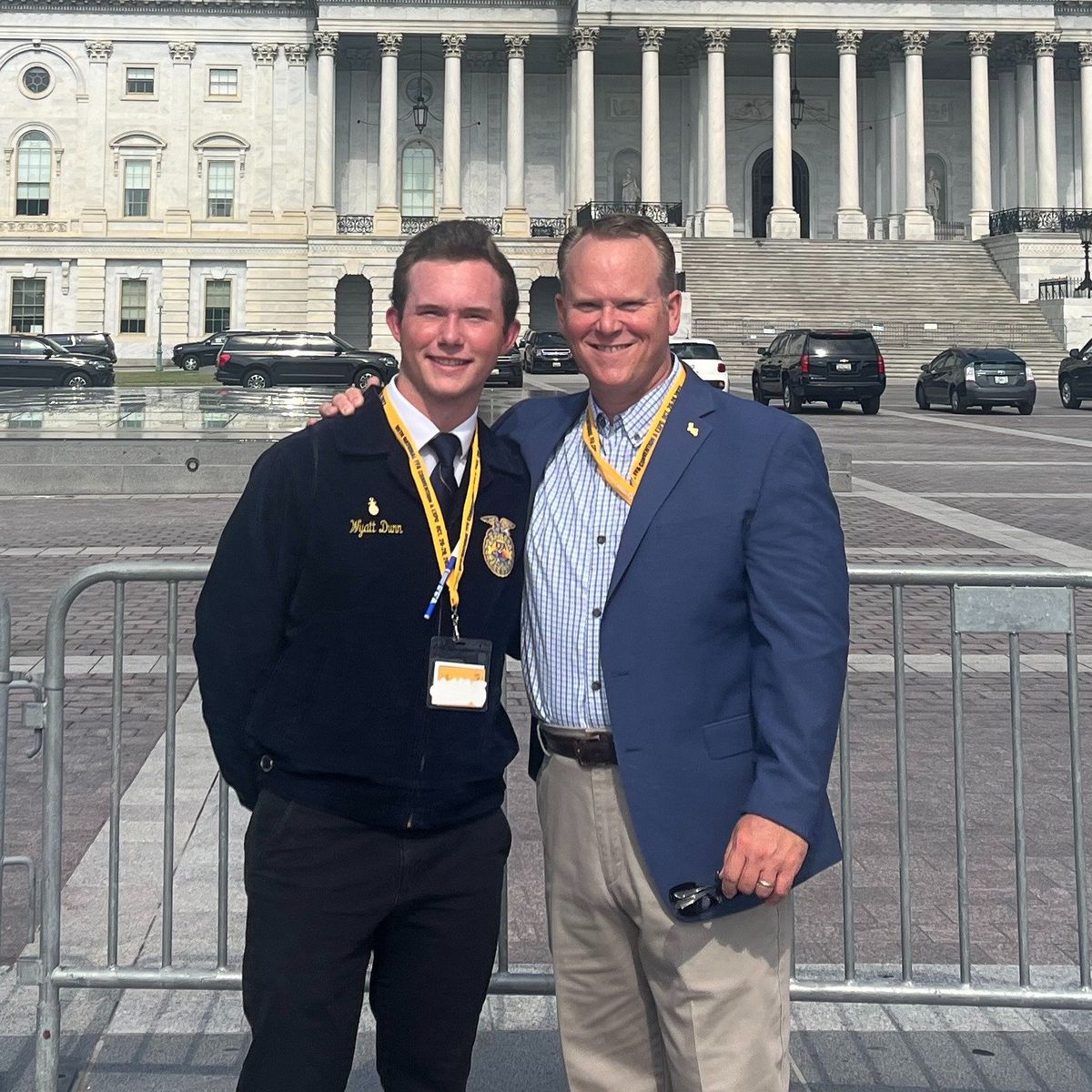
Jake is shown here with his son, Wyatt a senior at Petaluma High School, serving as. Chapter Vice-President.
FFA members over the years
♦️♦️♦️
This is an ongoing series from the team about local community members. If you have any recommendations of who we should meet, please message in the comments!