
Executive Function Coach Kinyatta Reynolds Opens Building Up Bold
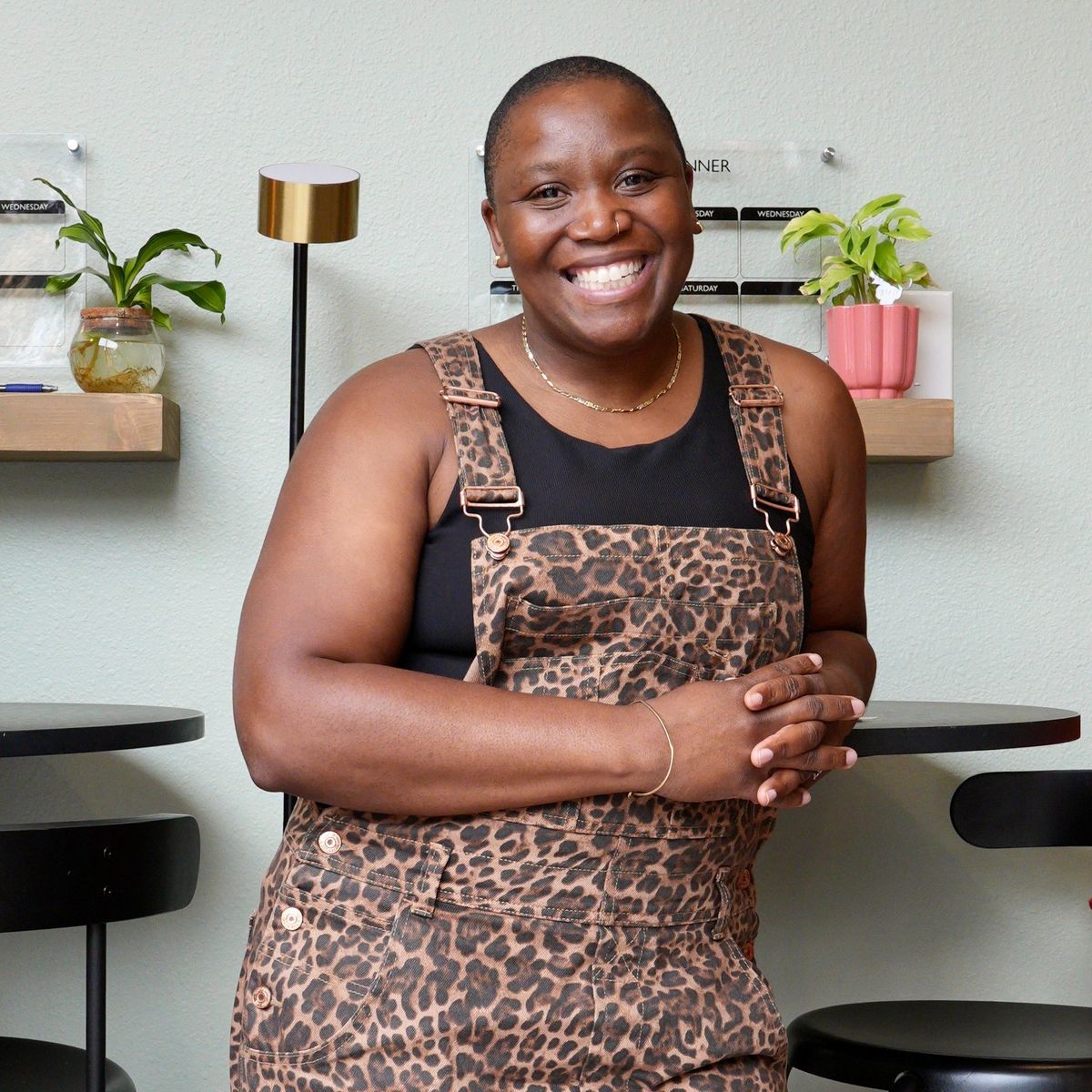
A coworking space for teenagers, where every object in the room is doing a job.
@Building Up Bold looks like somebody's house. There is a couch by the door that one student has never once gone past, a table you could eat dinner at, a room with a futon on the floor for the kid who likes to work lying down, and a desk bike at the end of the hall. That is all very intentional. @Kinyatta Reynolds set it up as a coworking space for teenagers, arranged like the rooms of a home, so that what they practice here transfers to where they work at their home. She explained it all as we walked the space.
Kinyatta is an executive function coach, and a Petaluma parent raising three children here with her husband. She studied sociology at the University of Washington, where she ran Division 1 track, and came to this work through residential youth care and teaching PE. She spoke at the national ADHD conference this year on boundary setting. She works with clients from third grade up through adults, and until this year she did it in their homes, in her home, and online. The storefront on Sonoma Mountain Parkway is new.
Executive function is the set of skills that runs all the other ones. Planning, getting started, keeping track of time, staying organized, moving from one task to the next, remembering what you were doing before you got interrupted. School assumes you arrive with them. For a lot of people, and for most people with ADHD, those skills show up late or unevenly or not at all, and no amount of being told to try harder installs them. Coaching is the teaching of the how.
In the rooms, everything has a reason
Time is invisible, which is a big deal for a lot of ADHD minds, so Kinyatta made it visible. There are clocks in every room. There is a timer with a colored disc that shrinks as the minutes go, so a student can watch an hour actually leave instead of guessing at it, which she says lets their body start to understand what time is doing. Ask a teenager how long they were paying attention in class and they have no idea. A room full of clocks and a timer they can watch is how they start to find out.
The wall calendar shows three months at once, because a single month hides both what is coming and what just happened. A project due October 15 stays comfortably far away until you can see it sitting there.
Supplies live in clear containers on open shelves rather than in drawers, because a drawer is where things go to disappear. She has strong feelings about drawers in general. "Why are you making your kids use drawers? It's a societal thing. Nobody says you have to have a dresser."
Phones do not come into the work rooms. She does not confiscate them, because they are not hers to take. Instead, the phone waits outside, and when a student goes to use it they mark it down on a sheet. This makes the invisible visible by letting a student see how many times they got up to check their phone. The intention is not punishment, the intention is accountability.
There are three Chromebooks on hand, so forgetting a laptop is not an excuse. One of the workstations has extra monitors, so a student who gets lost toggling between the reading and the assignment can see both at once, which removes the accidental slip into the wrong tab and whatever game is waiting there.
Before the crisis, not after
Most people find Kinyatta when things have already fallen apart, which she says is the hardest place to teach anything. She calls that the crisis time. "The crisis is hard, because then you're just trying to get out of the twenty eight missing assignments. It's hard to actually teach the skills because we're just grinding."
The space is her attempt at a room people can walk into before that crisis point. It only works, she is clear, if the student wants to be there. "If it's something their parents want them to do, it doesn't work. I want them to want to be here. And I always tell them, my goal is for you to not meet with me every week."
She spends as much time coaching parents as students, and a lot of that happens outside the building, walking through a family's house and watching how everyone moves through it, which is usually where the friction starts. Stop checking the grade portal. Ask noticing questions rather than accusations, and never ask a question you already know the answer to, because your kid knows you are setting a trap. "Every time you talk about your kid's homework, that's a relationship cracker."
She also handles the parts families do not know how to do, requesting 504 plans, sitting in on IEP meetings, emailing teachers when accommodations get ignored, and having students write their teachers a short introduction at the start of the year explaining what would otherwise get misread. This is a chance for them to explain that wearing their hood up is not disrespectful, or that being called on cold in class is genuinely hard. And nothing a student tells her reaches their parents without the student knowing first, exactly what will be said and when.
She is direct about where her work ends. Coaching is about the how and when. Therapy is about the why. Anxiety and depression travel with ADHD often enough that she sometimes stops and says the schoolwork is not the thing to work on right now. If the why is the part you need, ask her, because she has people to point you to.
What it costs and when it is open
Membership is $149 a month at the founding rate, which works out to around $25 a visit. Drop-ins are $30. No formal diagnosis is required for any of it. Kinyatta is capping it at fifteen members to start, which is what the space comfortably holds.
The lounge runs afternoons into the evening, closer to nine than to five, to accommodate students' after-school schedules. Mornings are open for independent study students, college students and adults who cannot get anything done at home.
She has a small team working with her. Two other executive function coaches, tutors for math and science and for writing, and a college essay workshop starting up once a month.
Building Up Bold is at 701 Sonoma Mountain Parkway, and there is an open house on Friday, September 19. Porchmail @Kinyatta Reynolds for the details, or have a look at buildingupbold.com.
📷: @Rachel Colla
♦️♦️♦️