

A Q&A with School Library Coordinator Sarah Rainey
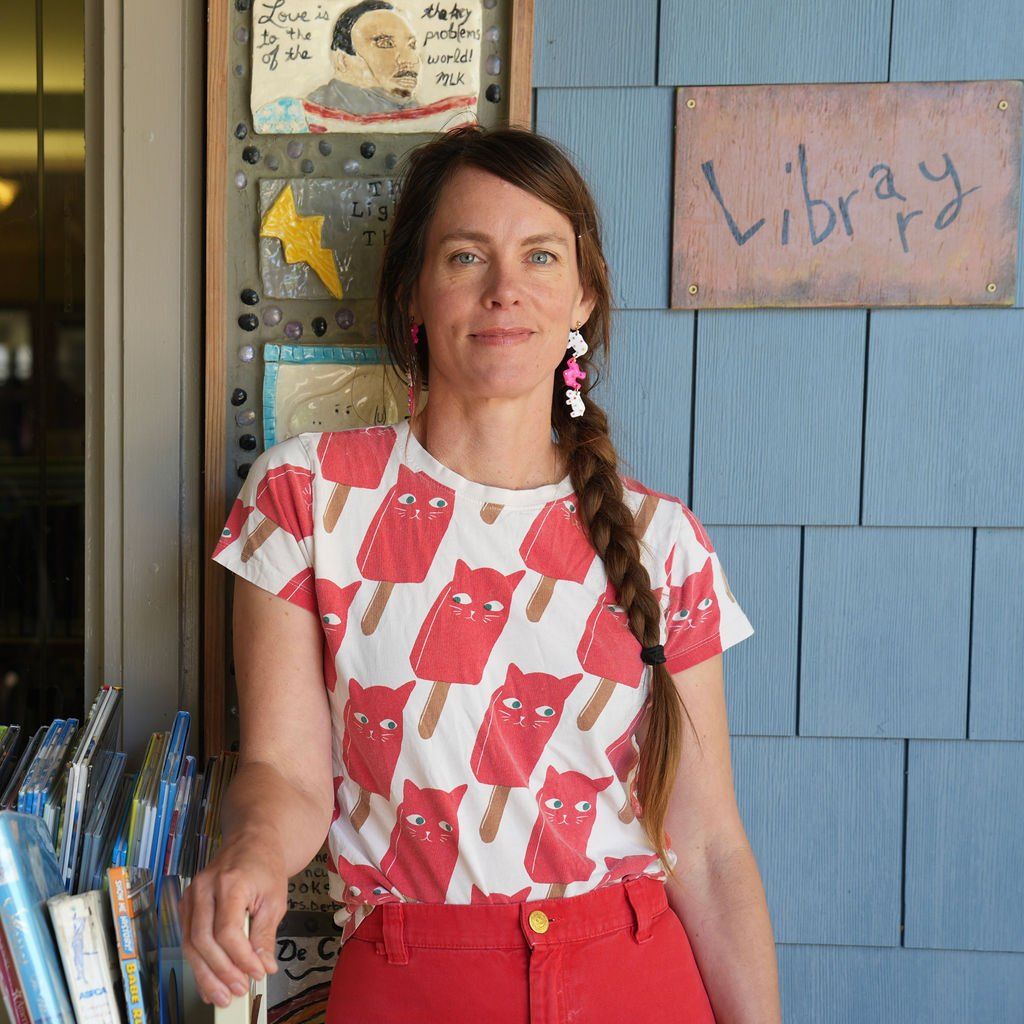
Step into the library @Mary Collins School at Cherry Valley and you won’t find shushing librarians, rigid rules, and lots of screens. Instead, you’ll find a cozy sanctuary where the girls cluster in the mornings before the bell, boys rediscover reading, and devoted volunteers organize stacks of returned books.
At the center of this literary ecosystem is @Sarah Rainey, a former Oakland vintage clothing store owner who traded hunting down the right inventory for her shop for hunting down the right book for the right kid. Although not required for the position, Sarah has a Master of Library Science, which she thought would lead her into museum work. But during her studies, @April Derby, who had been the librarian at Cherry Valley for 27 years, approached her about sharing her job. Sarah took the leap, and she has now been at the library for four years, the last two running the library on her own.
Cherry Valley serves over 500 students, transitional kindergarten through 8th grade, and each class goes to the library to see Sarah once a week. The Friends of Cherry Valley Library, a 501c3 founded about 20 years ago, supplements the library’s needs. It’s an impressive space, and the school’s support reflects that.
I sat down with Sarah in a side room, where she reads to classes, a space with tiered carpeted seating, a cozy rocking chair and throw pillows, two walls of books, and two walls of glass looking into the main library. We got into AI, why audiobooks count as reading, and how she builds a space of calm, curiosity, and inclusion for the students.
Lizzie: What are you reading right now?
Sarah: I just finished Young World by Soman Chainani. He came to do an author visit last week. The book is unusual: decommissioned classified documents, infographics. It’s a totally different way of telling a story. The kids picked it up and went, What is this?
Everybody wanted it. It’s perfect for the eighth-grade boy who turned his back on books and is hard to bring back.
During the visit we talked a lot about AI and using your own mind and your own creativity and what happens if you start using AI at this age to do your homework. You’re missing out, and the person that you might turn into might be lost. It was pretty heavy, but it was really good.
Lizzie: What’s your move when a kid says they don’t like to read?
Sarah: I talk to them about why, or what they’re into. You can’t push a middle schooler too hard. You just have to be there. It’s a fine line of making suggestions without it feeling like pressure, and making sure you have the right book in the collection for when they’re ready to come back around.
@Patty Norman from @Copperfield's Books is amazing at this. She’s one of my mentors for it.
Lizzie: What would you say to the parent whose kid will only listen to books or only read graphic novels?
Sarah: Audiobooks are books. That’s a hard line for me. Graphic novels are books. There’s no hierarchy. They’re the tool you need to get the story into your mind.
Lizzie: How do you think about screens and devices in the library?
Sarah: We really don’t use devices in here. I tried having kids use the online catalog the last few years. With 32 middle schoolers in here while I’m doing everything else, it ended up feeling like I was chasing people around and policing them. So now, no.
Once in a while I’ll put something up on the screen. An author’s book trailer, an artist’s work during a biography. That’s about it.
Lizzie: A lot of librarians right now are debating whether to genrefy the library. Where are you on that?
Sarah: It’s the biggest debate in library land right now. The case for it is real. Little kids come in wanting a book about a thing. A unicorn, a bear, mysteries. The way we’re arranged, by author last name, is great for adults and not so great for a five-year-old. Helping kids self-serve is good for everybody. The argument against it is that they then go to a public library and don’t know how to find anything.
We’re partway in. Our middle school PBL class, which is project-based learning, decided as a group that they wanted to add genre stickers to the books. So we did that. The young adult and middle grade fiction sections might eventually get reshelved by genre. We haven’t fully committed.
I’m not sure where I’ll land. The kids really want it.
Lizzie: What’s a thing parents can do at home to support young readers?
Sarah: Family accounts. That’s something we offer here that’s a little unusual. In addition to the limited number of books a student can check out each week, families can come in and check out as many as they want. I have one family with 100 books checked out at a time. They literally have a special backpack for it. Just having books on hand all the time really matters.
Lizzie: What do you want kids to take with them from the library, beyond a book?
Sarah: A feeling of calm and a little peace. That’s what I’m trying for. There isn’t a lot of quiet in a kid’s day. We never get to 100% quiet in here, but the goal is a little space to breathe and enjoy looking at something. That’s it.
Lizzie: If you could swap jobs with anyone for a week, no rules?
Sarah: I really loved working with Connie in the Petaluma History Room at the public library, helping people learn about the history of their house, things like that. There’s a part of me that would still love to do that.
Hot tip: Sarah’s 3 picks
● For middle school readers who’ve stopped reading or never started: Young World by Soman Chainani. Unusual format, immediate hook, brings reluctant readers back.
● For middle school students and their parents to read together: Accountable by Dashka Slater. A true story about social media and a high school in Albany. Timely and worth the conversation.
● For middle grade readers who love historical fiction: The Lions’ Run by Sara Pennypacker.
📷 by @Rachel Colla
♦️♦️♦️
This is an ongoing series from the team about local community members. If you have any recommendations of who we should meet, please message in the comments!